
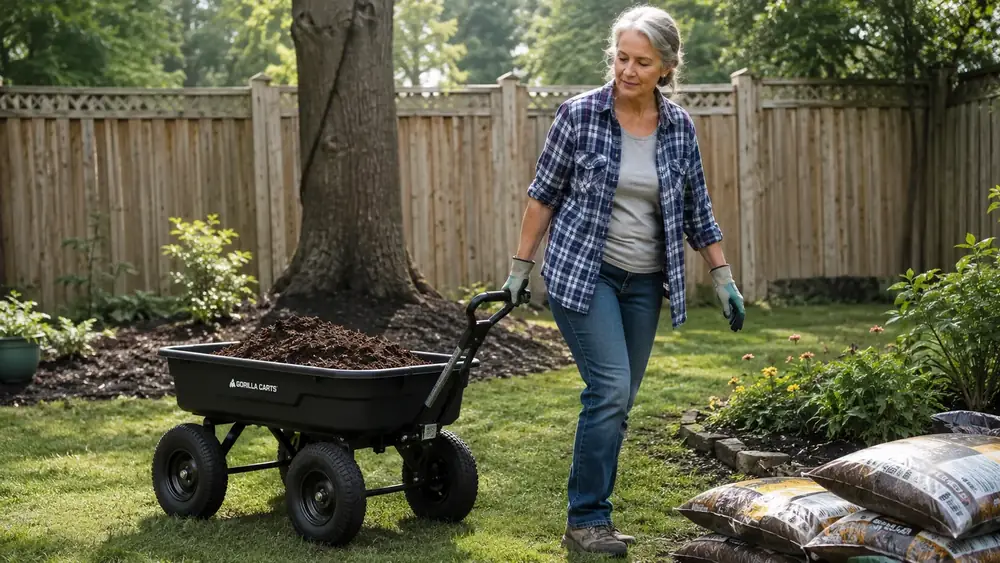
Last April I ordered fourteen yards of mulch for the beds along our back fence line, the kind of order that sounds perfectly reasonable over the phone and then looks like a small mountain once the truck dumps it in the driveway. Two summers earlier I would have moved that pile to the beds five gallons at a time in an old rubber tub, and by the second day my lower back would be locked up tight enough that my husband Del had to help me out of the recliner. This year went differently because I finally bought a real dump cart, a Gorilla Carts poly-tub model rated for 1200 pounds with a 6 cubic foot tub and real pneumatic tires, and I moved that entire fourteen yard pile in a day and a half without a single twinge. If you're still hauling mulch, soil, or yard debris by hand or by the bag, this is the routine I wish someone had handed me five years ago.
A garden cart earns its keep on exactly the jobs that wreck your body if you tackle them any other way. Dragging a fallen branch pile to the curb after a storm. Hauling wet leaves out of the beds every October. Moving a truckload of topsoil from the driveway to a new bed forty feet away, one shovel load at a time. A wheelbarrow works fine for small jobs, but it tips easily when it's loaded wrong and forces you to carry most of the weight through your arms and shoulders with the wheel doing almost none of the work it's supposed to. A dump cart, sized and loaded right, turns a full day of hauling into an afternoon, and it does it without leaving you sore for the rest of the week. Here's exactly how I use mine, step by step, from the first shovelful to the last dump of the day.
Stop Carrying What a Cart Was Built to Pull
If your idea of hauling mulch is still a five-gallon bucket and a bad attitude, a proper dump cart changes the math completely. The Gorilla Carts poly dump cart I use has a 6 cubic foot tub, a 1200 pound haul capacity, real pneumatic tires that roll over grass and gravel instead of digging into it, and a quick-release dumping handle that tips the whole load in one motion instead of you shoveling it back out by hand.
Amazon Check Today's Price on Amazon →Step 1: Size Your Load to the Cart Before You Start Shoveling
Before you throw the first shovelful in, do the quick math on what you're actually moving. A 6 cubic foot tub sounds small until you remember that a lot of hauling jobs, mulch, mixed soil, small branches, don't need to be piled to the rails to be a full, worthwhile load. Wet soil and wet mulch are heavier than they look, and a cart rated for 1200 pounds will hit that limit on volume long before it hits it on weight if you're moving something dense like topsoil or gravel. I fill about three-quarters full for anything heavy and reserve a full-to-the-rails load for lighter material like dry leaves or grass clippings. When I'm not sure how a new delivery of soil or mulch will weigh, I load one modest test batch first and gauge how the cart handles before I commit to filling it any fuller.
This is also where the tires matter more than people expect. Solid rubber tires on a cheap garden cart dig into soft lawn and bounce hard over roots and gravel, which shakes the load loose and shakes your joints too. Pneumatic tires, the kind with real air in them, roll over that same rough ground and absorb a lot of the jolt before it ever reaches your hands. If your route from the driveway to the beds crosses grass, gravel, or a bumpy side yard the way mine does, don't skip this detail when you're sizing up a cart in the first place.
Step 2: Load Heavy Materials Low and Centered Over the Axle
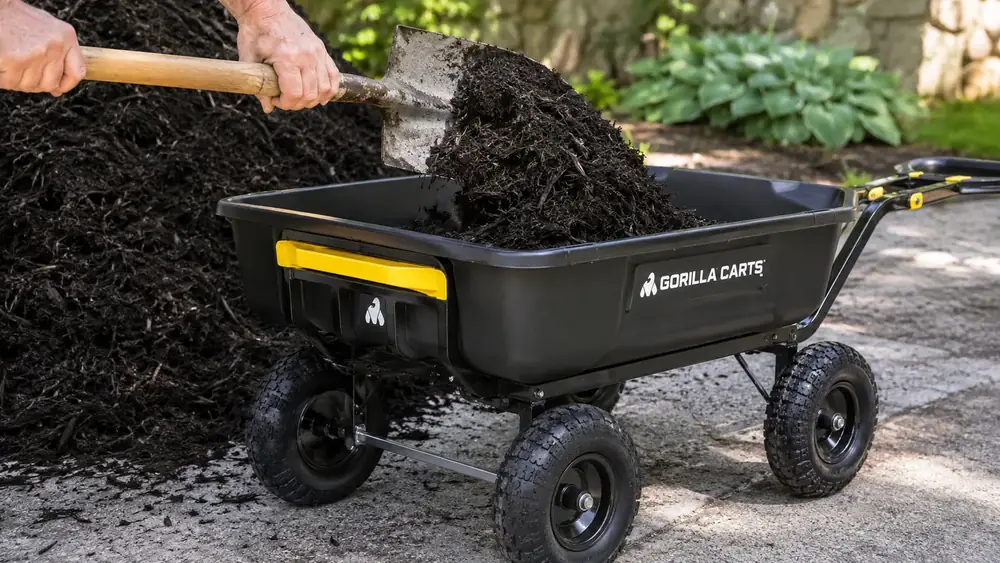
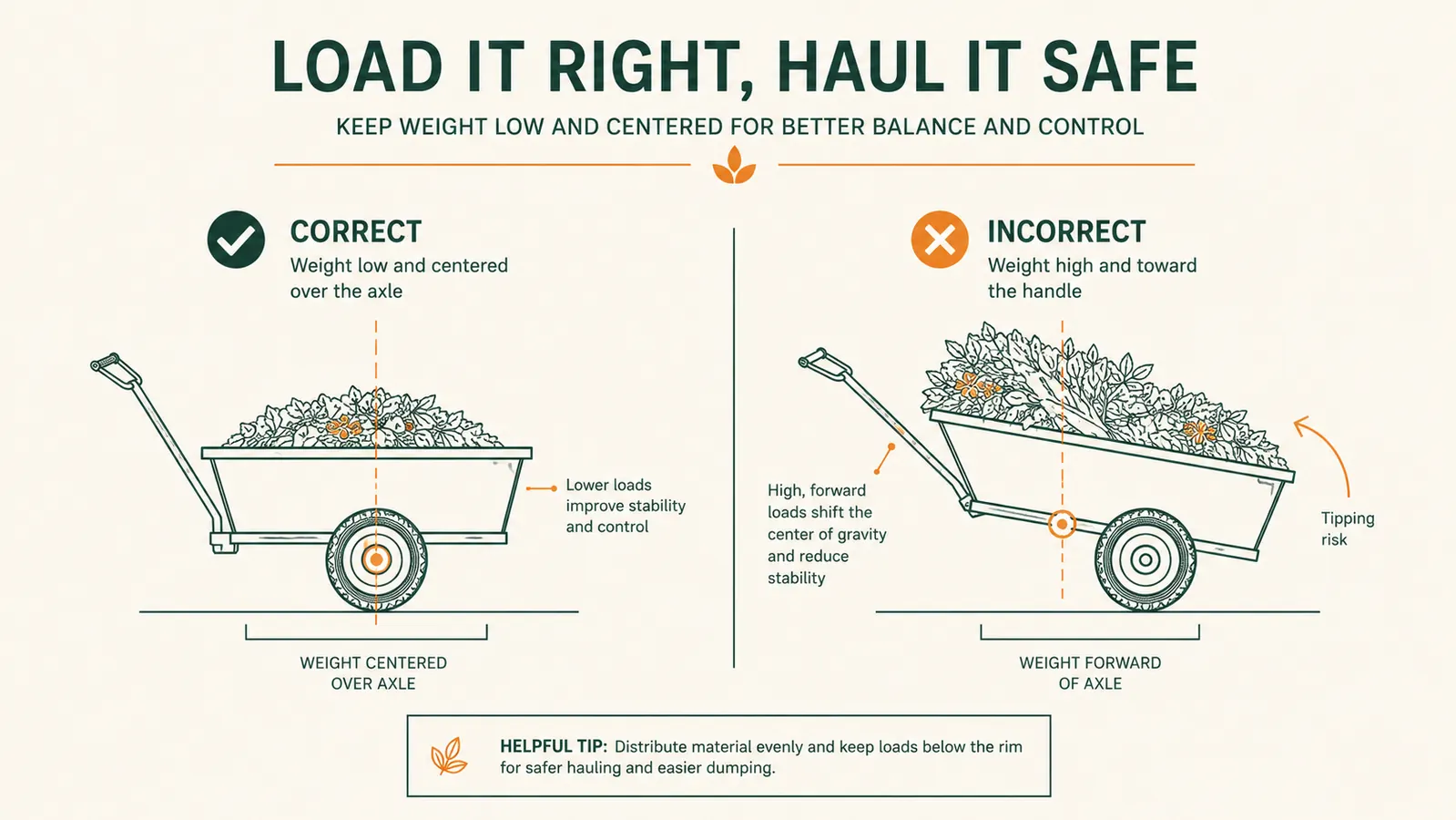
How you load a dump cart matters just as much as how much you put in it. Heavy, dense material like soil, mulch, or gravel should go in first and stay low in the tub, centered as close to directly over the wheels as you can manage. Lighter, bulkier stuff like pulled weeds or small brush can go on top. Load it backward, heavy toward the handle end instead of the wheels, and the cart gets nose-heavy the second you lift the handle, which is exactly the strain on your arms you bought the cart to avoid in the first place.
For loose material like mulch or small yard debris, I line the tub with an old tarp before I start shoveling. It doesn't slow down loading, and it saves a mountain of raking later because it means nothing sifts down into the tub's corners or drips a wet mess along your route. When I'm hauling something wetter, like a load of soaked leaves after a rainstorm, that same tarp lets me gather the corners and lift the whole load out in one motion at the destination instead of shoveling it back out by hand.
One more habit worth building: don't load the cart to the point where you can't see over the front of it while you're walking. That's less about weight and more about visibility on uneven ground, tree roots, hose reels, the dog's favorite chew toy left in the yard, all the stuff that trips you up when you're focused on the handle instead of the ground three feet in front of you.
Step 3: Pull With Your Legs, Not Your Lower Back
This is the step that actually saves your back, and it has nothing to do with the cart itself. Grip the handle with your elbows slightly bent, stand up straight, and start the pull by stepping forward and engaging your legs, the same way you'd start walking normally, rather than yanking the handle up toward your chest with your arms and shoulders. A loaded dump cart on good tires needs a fraction of the effort a loaded wheelbarrow does, but only if you let the wheels do the rolling instead of muscling the whole thing forward with your upper body.
Walk the route before you make the first trip, especially if you're hauling a lot of loads back to back. I scout for the flattest, most direct path between the pile and the destination, moving hoses, garden stakes, and stray branches out of the way ahead of time. It sounds like an extra step, but clearing the path once saves you from having to stop, reroute, or jerk the cart sideways around an obstacle on every single trip, which is exactly the kind of sudden twisting motion that tweaks a lower back.
Step 4: Handle Turns, Slopes, and Soft Ground Slowly
A loaded dump cart handles differently than an empty one, and the two places that catch people off guard are turns and slopes. Take turns wide and slow rather than pivoting sharply, since a sharp turn with a heavy, centered load can shift weight to one side fast enough to tip the tub. On any kind of grade, even a gentle one, keep the cart below you rather than above you when you can, meaning you're pulling it uphill or holding it back downhill instead of letting gravity do the steering for you.
Soft or muddy ground is its own challenge. Pneumatic tires help a lot here compared to solid tires, but a fully loaded cart can still sink and drag in wet soil. If I know I'm hauling through a soft patch, wet grass after a night of rain, a low spot near the downspout, I either lighten that particular load or plan a slightly longer route across firmer ground. It costs a few extra minutes and saves me from having to wrestle a stuck cart out of the mud, which is worse for your back than any amount of proper pulling technique.
It's also worth a quick check of your tire pressure before a big hauling day, the same way you'd glance at a wheelbarrow tire before a full season of use. Pneumatic tires lose a little air over the winter sitting in the shed, and a slightly underinflated tire makes the cart pull harder and track less true, especially fully loaded. A cheap gauge and a minute with a bike pump before your first big mulch or soil delivery of the season saves you fighting the cart on every trip that follows.
Step 5: Dump the Load Without Having to Do It Twice
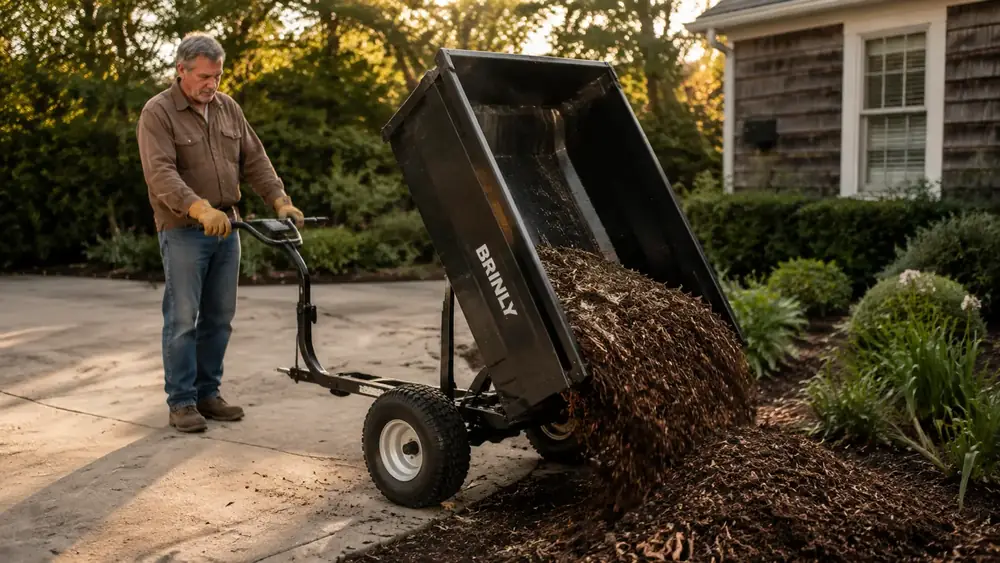
Position the cart at the destination before you release anything, not after. Line it up so the tub tips in the direction you actually want the material to land, whether that's along a bed edge, into a wheelbarrow-sized pile for spreading, or straight into a debris trailer. A quick-release dumping mechanism, the kind that lets you tip the tub with one motion at the handle, is the whole reason a dump cart beats a standard garden cart for this kind of work. You're not shoveling the load back out by hand, you're releasing it in one clean motion and moving on to the next trip.
For mulch and soil, I dump in a controlled tip rather than an all-at-once dump, easing the handle down so the material spreads in a rough line instead of landing in one dense pile I then have to spread out with a rake anyway. For debris headed to the curb or a trailer, a full fast dump is fine since I'm not trying to control the shape of the pile. Either way, check that the tub swings back to its locked, upright position before you load the next batch. A tub that's still tilted when you start shoveling again is how material ends up back on the ground instead of in the cart.
The back doesn't wreck itself hauling mulch. It wrecks itself hauling mulch the hard way, one armload at a time.
What Else Helps
A dump cart handles the bulk of the work, but a few other things make hauling season go smoother. A garden fork loads mulch and loose soil faster and with less bending than a flat shovel, since the tines slide into a pile more easily than a blade does. Real work gloves, not thin gardening gloves, save your hands over a long day of loading and unloading. I also still keep a small wheelbarrow around for the spots a full-size dump cart can't reach, the narrow side yard between our house and the fence, mainly, where there's not enough clearance to turn a wider cart around. Between the two, there isn't a corner of our yard I can't get mulch, soil, or debris into or out of without carrying it by hand. And at the end of the season, I hose the tub out and let it dry before it goes back in the shed, since caked-on wet mulch left over winter is the fastest way to age a poly tub before its time.
Get the Cart Before Your Next Mulch Delivery Shows Up
If you've got a mulch or soil order coming, or a debris pile that's been sitting there since the last storm, don't do that hauling by hand or bucket. The Gorilla Carts poly dump cart I use, with its 1200 pound capacity, pneumatic tires, and quick-release dump handle, turns a weekend of sore muscles into an afternoon that actually gets finished before dinner.
Amazon Check Today's Price on Amazon →