If you've only got room on your belt for one tool this fall, here's my honest answer after thirty-some years of digging in this yard: the PERWIN hori hori knife earns the spot nine times out of ten. It digs, it weeds, it cuts twine, it measures planting depth right off the blade, and it does all of that with one full-tang piece of steel that a trowel simply can't match. My old aluminum trowel still lives in the shed, and I still reach for it, but only for the one job it does better than anything else.
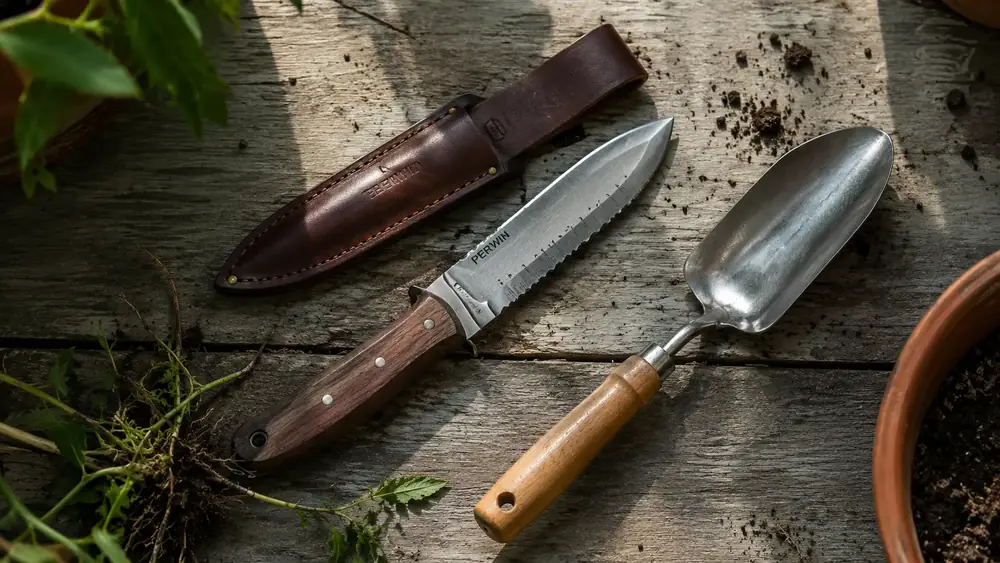
I've owned both for longer than I care to admit, and the difference isn't just marketing copy on the packaging. A hori hori is built like a short, sturdy knife with a concave blade, a sharpened edge on one side and a serrated edge on the other, seven inches of stainless steel on the PERWIN I use, with a full-tang walnut handle that runs the length of the grip instead of stopping where the blade meets the plastic. A trowel is a scoop. That's it. It moves loose soil from one place to another and that's about all it was ever designed to do.
I put both tools through the same job side by side this past October: digging and dividing a crowded daylily clump, planting forty tulip bulbs along the front walk, and clearing a patch of quackgrass that had crept into my asparagus bed. Same hands, same soil, same afternoon. What follows is what actually happened when steel met dirt, not what either package promised.
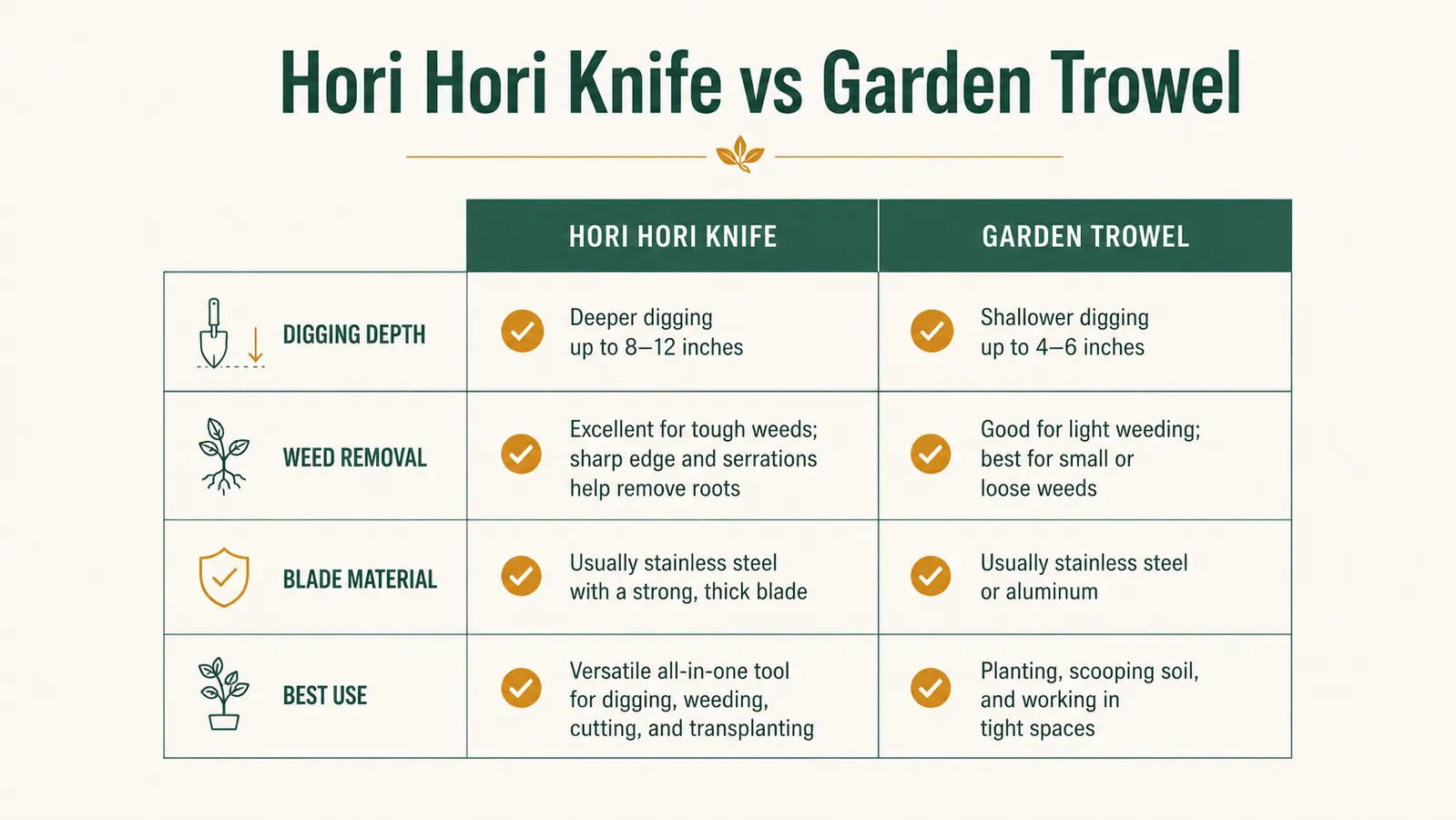
| Spec | PERWIN Hori Hori Knife | Classic Garden Trowel |
|---|---|---|
| Blade Material | 7" full-tang stainless steel, sharpened and serrated edges | Stamped aluminum or thin steel, single scoop edge |
| Best For | Weeding, dividing roots, cutting twine, deep digging | Scooping loose potting soil into containers |
| Digging Depth | Cuts straight down through compacted or rooty soil | Struggles once soil firms up or hits roots |
| Weed Removal | Serrated edge saws through taproots cleanly | Pries and snaps roots, often leaves pieces behind |
| Handle Durability | Full-tang walnut handle, no weak joint to snap | Plastic or riveted handle, common failure point |
| Extra Uses | Measures planting depth, cuts landscape fabric and twine | None, single-purpose scoop |
| Comes With Sheath | Yes, belt sheath included | Rarely, usually loose in the tool bucket |
| Price Range | Check today's price on Amazon | Inexpensive |
Where the PERWIN Hori Hori Knife Wins
The daylily division was the job that really sold me. Daylily roots grow into a dense, fibrous mat, and a trowel just bounces off it or wedges in sideways without cutting through. The PERWIN's sharpened edge sliced straight down through the clump in three cuts, and I had four healthy divisions ready to replant in about ten minutes. My trowel, when I tried it on a second clump for comparison, took closer to twenty-five minutes of prying, twisting, and eventually giving up and going back inside for the hori hori anyway.
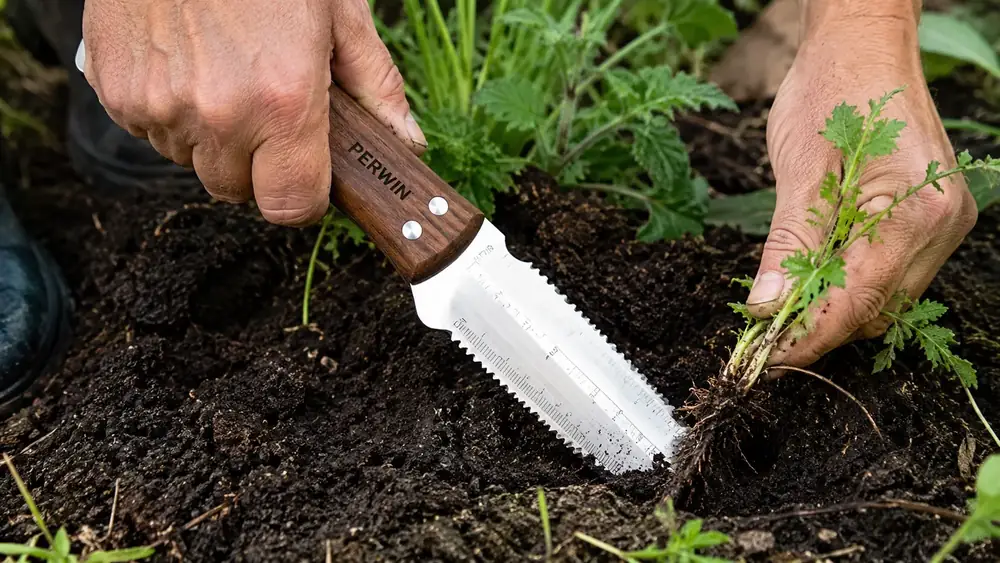
Weeding is where the serrated edge really shows its worth. Quackgrass sends runners underground that snap off if you pull from the top, and then you're back out there again in two weeks pulling the same patch. The serrated side of the PERWIN saws through the runner below the soil line, and the concave blade shape lets me pop the whole root system out in one motion instead of chasing broken pieces with my fingers. I cleared about eight feet of asparagus bed edge in under fifteen minutes, something that used to eat most of a Saturday morning with a trowel and a lot of muttering.
Planting the tulip bulbs showed off a feature I didn't expect to care about but now use constantly, the measurement markings etched right into the blade. Tulips want a hole about six to eight inches deep, and instead of eyeballing it or running back for a ruler, I just plunge the blade in and read the line. Forty bulbs went in on one afternoon without a single one planted too shallow, which used to be my most common mistake with a trowel where depth is basically a guess.
The full-tang walnut handle matters more than it sounds like it would. I've snapped two cheap trowels at the neck, right where the blade meets the plastic handle, usually while trying to pry a rock or a stubborn root out of clay soil. That weak point doesn't exist on the PERWIN. The steel runs the full length of the handle, so when I lean into a tough patch of compacted soil near the foundation, the tool flexes a little and holds instead of cracking off in my hand halfway through a job.
Transplanting is another spot where the two tools aren't even close. Moving a young hosta or a pot-bound coneflower means slicing straight down around the root ball to free it from the surrounding soil before you can lift it out cleanly. The PERWIN's blade does that in one motion, straight in, straight down, straight out, with the root ball intact. A trowel wants to scoop and pry from an angle, which tends to shear off the finer feeder roots on the outside of the ball, and I've watched transplants sulk for a week afterward because of exactly that kind of rough handling.
It also earns its keep in ways that have nothing to do with digging. I use it to cut twine off a bundle of stakes, slice open a bag of mulch, and split apart root-bound perennials I'm potting up for the plant swap. That kind of do-it-all usefulness is exactly why it lives on my belt in the sheath that comes with it, not rattling around loose in a bucket where I'd have to go hunting for it every single time.
Where a Garden Trowel Wins
I'm not going to pretend a trowel is useless, because it isn't. When the job is scooping loose potting mix into containers or filling in around a transplant that's already got its hole dug, the wide, cupped shape of a trowel moves more soil per scoop than the narrower hori hori blade ever will. Every spring when I'm potting up forty or fifty seedlings for the porch boxes, I still reach for the trowel because it's simply faster at shoveling soil, not cutting through it.
A trowel is also lighter and a little easier to hand to a grandkid who wants to help in the garden without worrying about a sharpened edge. There's no serration to catch a small finger, no blade to keep track of, just a rounded scoop that does one gentle job. If you're mostly doing container gardening, raised bed topping off, or working with kids in the dirt, the simplicity of a trowel is genuinely the right call, and I'd never talk someone out of keeping one around for exactly that reason.
Seed starting is another job I still hand to the trowel. Filling forty little cell trays with seed starting mix is a scooping job through and through, and the wide bowl of a trowel gets it done in a fraction of the time a narrow hori hori blade would take. I fill my trays on the porch every March with the same cheap trowel I've had for a decade, and there's no version of the hori hori that would speed that particular task up.
There's a cost angle worth naming honestly too. A basic trowel runs eight to fifteen dollars most places, less than the PERWIN, and if all you need is something to fill hanging baskets and pot up a few tomato starts every spring, spending more on a hori hori doesn't buy you anything you'd actually use. It's a fine starter tool, and plenty of gardeners get by on one for years without ever feeling like they're missing something.
Stop wrestling weeds that snap off at the top
If you're pulling quackgrass, dividing perennials, or planting bulbs this fall, the PERWIN hori hori knife cuts through root systems a trowel just can't reach.
Amazon Check Today's Price on Amazon →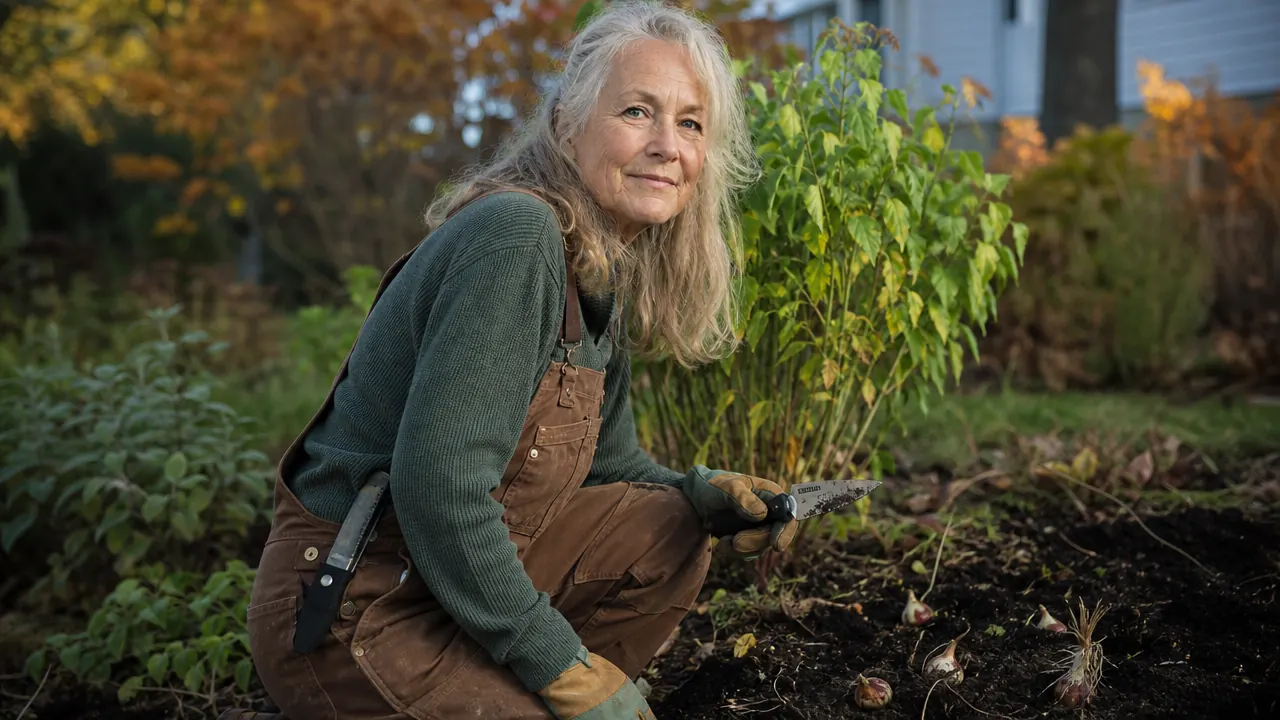
Who Should Buy Which
If you've got established beds with real weed pressure, perennials that need dividing every few years, or bulbs to plant every fall, get the PERWIN hori hori knife. That's true whether you're maintaining a single cottage bed or a full backyard's worth of borders like mine. The measurement markings alone will save you from the shallow-bulb mistake I made for years before I owned one, and the serrated edge handles taprooted weeds, dandelion, quackgrass, thistle, that a trowel just can't cut through cleanly.
If your gardening is mostly containers, hanging baskets, and topping off raised beds with fresh soil, a plain trowel does that job fine and costs less. Plenty of gardeners end up owning both, that's honestly where I landed after years of trial and error. The trowel lives in my potting shed for soil-scooping jobs, and the hori hori stays clipped to my belt for everything that grows roots.
Upkeep is worth mentioning too, since it factors into which tool actually stays useful over time. I wipe the PERWIN's blade down with an oiled rag after a muddy session and touch up the sharpened edge with a small file once or twice a season, and it keeps cutting like new. A trowel needs almost no maintenance at all, there's no edge to protect, which is one more small point in its favor if you'd rather not think about tool care between growing seasons. But a dull hori hori is still miles ahead of a trowel on root work, so the little bit of upkeep pays for itself fast.
One more thing worth saying plainly, if you're newer to gardening and only want to buy one hand tool for the next several seasons, buy the hori hori. Almost everything a home gardener does in a normal year, weeding, dividing, planting bulbs and transplants, cutting through the occasional stubborn root, is a job the hori hori handles and a trowel doesn't. You can always pick up a cheap trowel later for container work. Starting the other way around means fighting roots with a scoop for years before you realize what you're missing.
The full-tang construction is also why I trust the PERWIN to hold up. Mine has been through two full growing seasons now, left out in a light rain more than once, dropped on the patio stones, wiped down with an oiled rag maybe every other month, and the blade still holds an edge and the handle hasn't so much as loosened. That's the kind of tool you buy once and keep for a decade, not the kind you're replacing every spring after the handle finally gives out.
So here's where I land, plainly. Lead with the hori hori as your main digging and weeding tool, and keep a trowel around strictly for scooping soil into pots and baskets. That order rarely lets you down. Reverse it, lead with a trowel on real weed pressure and root-bound perennials, and you'll spend seasons wondering why your beds never quite look as clean as your neighbor's.
One tool that digs, weeds, and measures
Grab the PERWIN hori hori knife before your next planting weekend and see how much faster the weeding goes when the blade actually cuts through the root.
Amazon Check Today's Price on Amazon →